Tutorial: robust stacking against satellites, hot pixels and clouds
Goal: decide whether a capture needs an outlier guard, switch on the right one, see it remove a real artefact from a real capture, and know what it does not do.
You need: any capture; for the worked example, 15_20_57.ser (ASI482MC,
1920 x 1080, 16-bit, H-alpha, 2022-07-17) or a capture of your own. The method
and the measurements are in
How stacking works, section 5;
this page is the worked example.
What is real on this page. Everything in sections 3 and 4 and in the troubleshooting list was run on
15_20_57.serwith the current build: the damage is written into the real frames, the stacks are real, the numbers are measured. The chart in section 2 is the project's synthetic known-answer test (real captures have no damage with a known answer), re-run on the same build.
1. What the guards do
The default stack is a quality-weighted mean of the best frames. It is the right answer for seeing-selected lucky imaging, where the spread between frames is partly signal. A mean has one weakness: a sample that does not belong at all (a satellite or plane trail, a cosmic ray, a bird, a cloud dimming a few frames, a hot pixel that the alignment moves from frame to frame) pulls the mean by its full size divided by the number of frames.
--robust adds a first pass that collects, at each pixel, the sum and the sum of
squares of the samples, and a second pass that judges each sample against the
mean and spread of the other samples at that pixel:
--robust |
A sample more than K standard deviations from the mean of the others is | Default K (--robust-k) |
|---|---|---|
none |
kept: the weighted mean (the default) | |
sigma |
dropped | 2.5 |
huber |
given less weight the further out it is (K sigma divided by its distance) | 1.345 |
winsor |
clamped to K sigma from the mean | 2 |
K is a positive number of standard deviations. --sigma-clip K is the older
spelling of --robust sigma --robust-k K, and cannot be combined with --robust.
At a pixel with fewer than three samples nothing is changed; from six samples up
the sample being judged is left out of the spread it is judged against, so a
spike cannot hide inside the spread it causes. The capture is read twice
instead of once.
Two details matter, and both were found by the real-frame test below. The mean and spread that judge a sample ignore the frame quality weights: the weights say how much a surviving sample counts in the result, not how much it is believed. (A frame with a satellite in it often scores better, because the trail's edge is sharp detail, and a spread weighted by those scores hides the trail inside it.) And with alignment points, the whole-frame image that fills between the points is stacked under the same rule as the points themselves.
2. Which to choose
The synthetic test (200 frames of a 48 x 48 scene, noise 0.02, default K;
cargo test -p helia-core --all-features --test robust_stack -- --nocapture)
measures the error against the truth, times 1000 (re-run for this page on the
build with the fix):
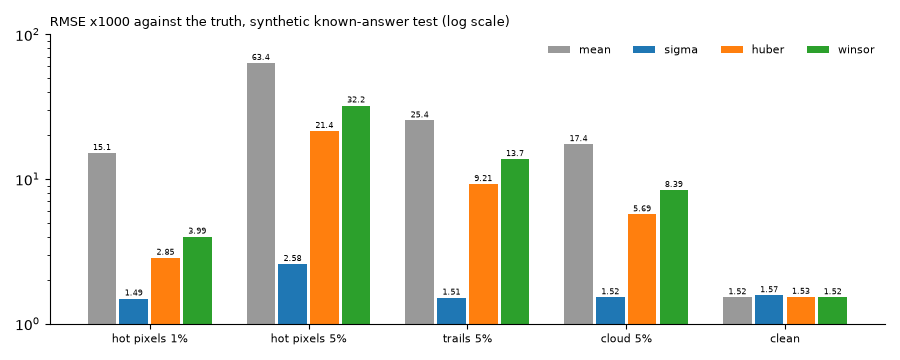
Drawn from the table in How stacking works, which has every damage type and share.
sigmaremoves gross outliers best: it is the choice for a hot pixel or a trail. At 5% hot pixels its error is 2.58, against 21.45 forhuberand 32.20 forwinsor.winsoris the gentlest on real, asymmetric spread (it moved the result 0.43 from the weighted mean, against 0.98 for sigma and 1.32 for Huber, times 1000, when one sample in five was pulled down by 0.05). Use it when you want a safeguard and not a cleaning.hubersits between them on outliers and moves the result most on real spread; raise K (--robust-k 2) if that matters.- None of them is a cure for bad alignment.
A good first try for a capture with a known artefact: --robust sigma. For a
capture with none, leave it off.
3. Worked example: a line and hot pixels in real frames
To see a guard work on a real capture, damage it in a way you know the answer to.
The script below copies the first 20 frames of 15_20_57.ser and writes into the
raw frames, in sensor coordinates, before Helia ever aligns them: a 3 px wide
dark line down columns 1000 to 1002 (20000 of 65535 subtracted) in frames 4 and
13, and 300 hot pixels (+30000) in frames 8 and 16. That is how a satellite
trail or a cosmic ray arrives: fixed in one frame, at a different place on the
Sun once the frames are aligned.
# damage.py  SRC.ser DST.ser clean|damage     (Python 3, no packages needed)
# Written for this capture: its pixel data is little-endian whatever the header says.
import random, struct, sys
src, dst, mode = sys.argv[1:4]
n = 20
f = open(src, "rb")
hdr = bytearray(f.read(178))
_, colour, _, w, h, depth, _ = struct.unpack_from("<7i", hdr, 14)
struct.pack_into("<i", hdr, 14 + 24, n)            # the new frame count
out = open(dst, "wb"); out.write(hdr)
rnd = random.Random(1)
for i in range(n):
    b = bytearray(f.read(w * h * 2))
    if mode == "damage" and i in (3, 12):         # dark line, columns 1000-1002
        for y in range(h):
            for x in range(1000, 1003):
                o = (y * w + x) * 2
                v = struct.unpack_from("<H", b, o)[0]
                struct.pack_into("<H", b, o, max(0, v - 20000))
    if mode == "damage" and i in (7, 15):         # 300 hot pixels
        for _ in range(300):
            x, y = rnd.randrange(w), rnd.randrange(h)
            o = (y * w + x) * 2
            v = struct.unpack_from("<H", b, o)[0]
            struct.pack_into("<H", b, o, min(65535, v + 30000))
    out.write(b)
Stack the clean copy once and the damaged copy with each setting:
python damage.py 15_20_57.ser clean.ser clean
python damage.py 15_20_57.ser dmg.ser damage
helia stack clean.ser -o clean.fits --preset ha --keep 100% --align phase
for r in none sigma huber winsor; do
  helia stack dmg.ser -o dmg-$r.fits --preset ha --keep 100% --align phase --robust $r
done
With a guard on, the summary ends with a note about what it can and cannot remove (see section 4):
note: robust stacking removes what differs between frames (a satellite, a cosmic ray, a hot pixel the alignment moves); a defect fixed on the sensor sits on the same pixel in every frame and is not an outlier, use --dark or --bad-pixels for it
The picture is the proof. A crop of each stack around the line:
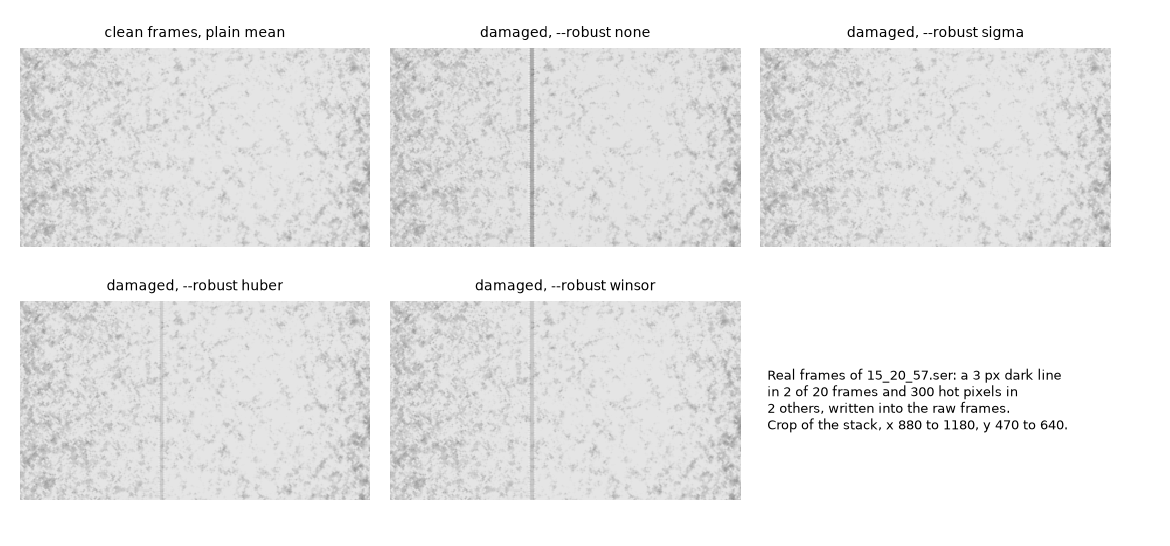
Stacks of 15_20_57.ser (20 frames, green plane, --preset ha --keep 100%
--align phase). The vertical line is the damage in two frames of twenty.
Top row: the clean frames, the damaged frames with no guard, with sigma.
Bottom row: huber, winsor. The hot pixels are far smaller than the line and
do not show at this size; the table measures them.
The same thing as numbers: the stack of the damaged frames minus the stack of the clean ones, averaged down the disc rows 300 to 800, at the worst column of the line (full scale is 1):
| Alignment points | --no-multipoint |
|
|---|---|---|
none |
-0.112 | -0.094 |
sigma |
0.000 | 0.000 |
huber |
-0.048 | -0.038 |
winsor |
-0.057 | -0.048 |
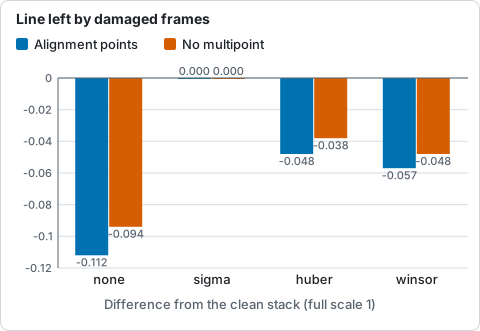
Stack of damaged frames minus the clean stack at the worst column of the line, with alignment points and without, from the table above.
sigma takes the line out completely. huber and winsor pull it back by
about half and no more: they down-weight an outlier, they do not remove it, and
here the damaged frames also carry high quality weights. That is the reason the
chart puts sigma first for gross outliers.
4. What robust stacking does not remove
The guards remove a sample that differs from the same place in the other frames.
A defect fixed on the sensor (a hot pixel, a dust spot, a dead column) is in
the same sensor pixel of every frame. The alignment moves each frame by its
drift, which on a steady mount is a fraction of a pixel: over these 20 frames it
was 0.45 px in x and 0.39 px in y. So at the stack pixel the defect is present
in all 20 frames and is not an outlier. Measured: writing the same 300 hot
pixels into every frame and stacking with --robust sigma left exactly the same
error as stacking with no guard (0.000340 mean absolute difference over the
region, both).
For those, use calibration: a dark frame or a bad-pixel map, applied before the frames are demosaiced and aligned. See Calibrate: darks, flats and bad pixels and Calibration. In short: robust stacking is for what moves or comes and goes; calibration is for what stays on the sensor.
5. What it costs on a clean real capture
15_20_57.ser (100 frames) with nothing to remove measures the cost: stacking
all 100 frames with each guard against the plain weighted mean of the same run
(--keep 100% --preset ha, FITS output), over the disc:
helia stack 15_20_57.ser -o clean-none.fits  --preset ha --keep 100%
helia stack 15_20_57.ser -o clean-sigma.fits --preset ha --keep 100% --robust sigma
helia stack 15_20_57.ser -o clean-huber.fits --preset ha --keep 100% --robust huber
helia stack 15_20_57.ser -o clean-winsor.fits --preset ha --keep 100% --robust winsor
| Guard | RMS difference from the mean (x1000, mean level 0.809) | Largest difference (x1000) | Time of the stacking step |
|---|---|---|---|
sigma |
0.45 | 8.09 | 0.89 s |
huber |
0.46 | 6.00 | 0.82 s |
winsor |
0.18 | 2.98 | 0.98 s |
| none | 0.46 s |
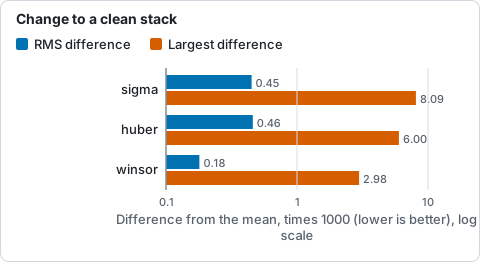
Difference of each guard from the plain mean on 100 clean frames of 15_20_57.ser (times 1000), from the table above.
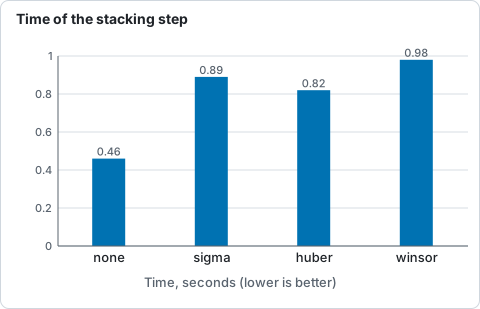
Time of the stacking step for 100 frames with each guard, on an A100 with Vulkan, from the table above.
On a capture with nothing to remove, the three guards change the picture by about half a thousandth of full scale (on a mean level of 0.809) and cost about half a second more on a GPU (A100, Vulkan). The capture is read twice, so the cost grows with the file.
6. On the command line
helia stack sun.ser -o sun.tif --robust sigma
helia stack sun.ser -o sun.tif --robust huber --robust-k 2
helia stack sun.ser -o sun.tif --sigma-clip 2.5       # same as --robust sigma --robust-k 2.5
7. In the app
- Open the capture and go to Stack.
- Find Outliers. The chips are Off (the default), Sigma, Huber and
Winsor. The app uses the default K of each (2.5, 1.345 and 2 standard
deviations); the slider for K is not in the app, so for another K use the
command line or the API (
robust_k). - Press Stack N frames. The run is slower, because the frames are read twice.
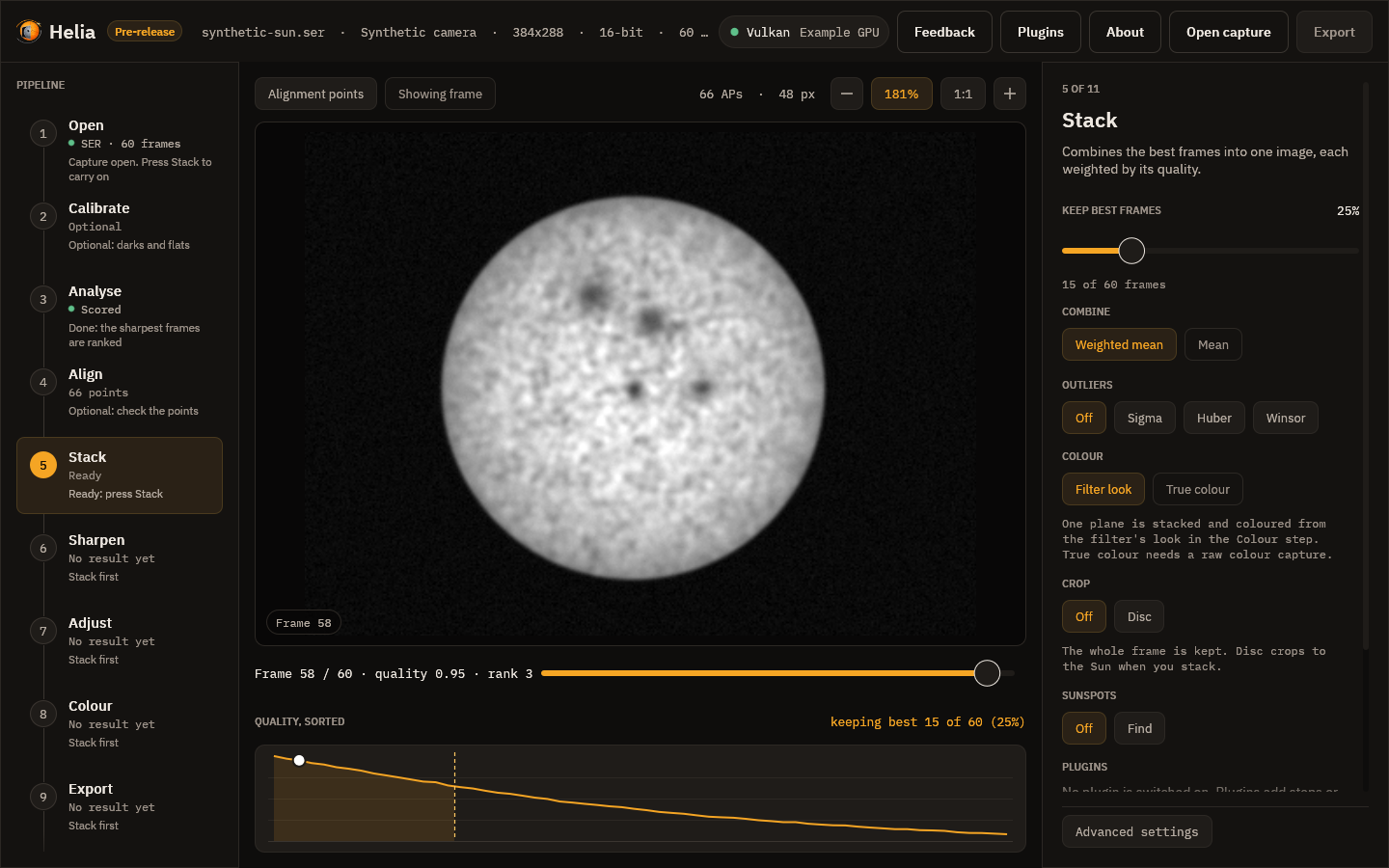
Drawn by the interface test harness on its synthetic demonstration capture; it shows where the chips are.
8. In the API
"robust": "sigma" and "robust_k": 2.5 in the job's config; see
The API and the API reference.
What to expect and how to tell it worked
- No sign in the summary beyond the longer stage time and the note; the proof is the picture. A trail or a hot pixel that was in the plain stack is gone, and nothing else moved.
- A change over the whole image (the level or the contrast) means the guard was doing more than removing outliers: on clean data the change should stay at the level in the table in section 5.
- Compare with and without on the same capture, in the Before / after view, zoomed to 100 per cent.
Troubleshooting
error: the following required arguments were not provided: --robust
  <ROBUST>
. You gave--robust-kalone. K only means something with a guard. Add--robust sigma(orhuber,winsor).error: the argument '--sigma-clip <K>' cannot be used with '--robust <ROBUST>'. Use one spelling:--robust sigma --robust-k K.helia: --robust-k must be a positive number of standard deviations. You gave 0 or a negative number.- It is slow. The capture is read twice. On
15_20_57.serthe stacking step went from 0.46 s to 0.9 s on a GPU; a long capture on a slow disc will show it more. Use--robustonly when the capture has something to remove. - A hot pixel, dust spot or dead column is still there. It is fixed on the sensor, so it is not an outlier (section 4). Use a dark frame or a bad-pixel map.
- A trail is still there. The guards judge each pixel from its frames
after alignment, so a trail is rejected only if it is far enough from the
others.
sigmaremoves the most;huberandwinsorpull a gross outlier only part of the way back (section 3). A faint trail, or a trail in many of the kept frames (the 5% rows of the chart), leaks through the soft forms, andsigmatoo when many of the frames carry it. If nothing helps, drop the affected frames by keeping fewer (--keeplower). - The artefact moved the whole stack a little. A frame with an artefact
scores higher (the trail adds sharp edges), so it could rank first and join
the reference. Helia now guards against this twice: a score that jumps well
above the frames either side of it is put back to their level before ranking
(the command-line summary then has a
ranking:line naming those frames), and the reference is the per-pixel median of the best five frames, so an artefact in one or two of them does not reach it. On15_20_57.serwith a line in two frames and hot pixels in two others, ranked on the whole frame, the stack moved 0.14 px before and 0.011 to 0.013 px now. What remains is damage too small to change the score (a few hot pixels raise it by 3 to 4%, less than the seeing varies): the median reference covers it. If you still see a shift, compare against a clean stack with the same frames excluded, or mask the artefact (--exclude) for the ranking. See How stacking works: ranking the frames. - The picture got softer or the contrast changed. The guard is working on
signal, not outliers: the spread between frames is partly real. Switch to
winsor, raise--robust-k, or turn it off. - A pattern remains in one place after the guard. A bad alignment point shifts its patch and a guard repairs only part of it (an error of 1.86 for the mean against 1.69 to 1.75, times 1000, in the synthetic test). Fix the alignment (Align).
See also
- How stacking works: stacking.
- Calibrate: darks, flats and bad pixels: the answer for defects fixed on the sensor.
- The command line and the
CLI reference:
--robust,--robust-k,--sigma-clip. - Using the desktop app: the Outliers chips.