H-alpha, full disc
Goal: a sharp, orange full-disc picture of the chromosphere from an H-alpha capture, as a 16-bit TIFF.
You need: a SER (best) or AVI of the full disc, a few hundred frames or more,
with the filter in the name (for example 2026-10-19_Sun_Ha_001.ser). See
Capturing for Helia.
In the app
- Open the file (Ctrl+O). Helia reads the filter from the name, so the Quick stack card says H-alpha detected and offers the red channel and the best 25 per cent of the frames. If the red plane is clipped (see below) Helia stacks the green plane instead and says so. If the name does not say, press H-alpha.
- Press Stack with recommended settings.
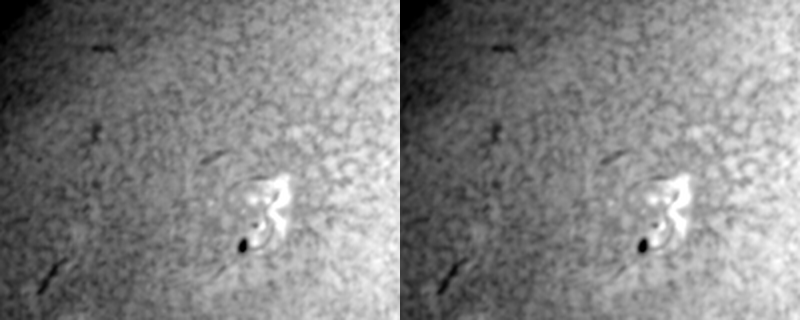
- On Sharpen, the recommended H-alpha wavelets are already on (gains 1.4, 3.2, 2.4, 1.6; noise cuts 3.0, 1.0, 0.5). Use Before / after to check they help, and ease a gain down if the grain looks coarse. To sharpen as in RegiStax, see Sharpening like RegiStax.
- On Colour, H-alpha is already selected. Try Invert for prominences.
- Export a TIFF 16-bit.
The pictures for each step, from a real capture, are in the walkthrough.
On the command line
This is the real output for a 100-frame, 1920 x 1080, 16-bit SER on a laptop with a mid-range GPU (the times are that machine's, not a promise):
input:    SER 1920x1080 16-bit, 100 frames
note:     The header flag says big-endian, but the pixel data only makes sense as little-endian; Helia reads it that way.
backend:  GPU (NVIDIA GeForce RTX 3050 Ti Laptop GPU (Vulkan, DiscreteGpu))
settings: H-alpha (chosen); red channel, keep 25%, alignment points 64 px
edit:     1. wavelet sharpen, 6 layers (dyadic from layer 1), default filter, amount/sharpen/denoise 100/0.063/0.30 100/0.148/0.10 100/0.118/0.05 100/0.077/0.00 100/0.000/0.00 100/0.000/0.00
[   0.8s] building reference
[   1.2s] aligning frames
[   1.9s] stacking
[   2.1s] sharpening and editing
[   2.1s] colourising
[   2.1s] writing
frames:  100 total, 25 kept, 50 registered
points:  615 of 2135 alignment points active
align:   phase correlation (limb fit not confident enough, 0.42); confidence mean 1.00, least 1.00 (sampled)
masked:  196 x 20 at (0, 0), filled from the sky around it
disc:    centre (788.4, 553.1), radius 447.2 px
detail:  stack 0.00106 vs best single frame 0.00115 (0.92x)
sharpened: detail 0.00137 after the edits, 0.00106 before (1.29x)
noise:   finest-layer sigma 0.00017 before, 0.00001 after the edits
timing:  scoring frames 0.52s, building reference 0.12s, aligning frames 0.24s, measuring alignment points 0.32s, stacking 0.45s, finishing 0.01s (total 2.18s)
wrote:   sun-ha.tif
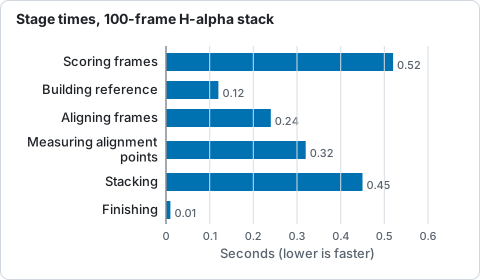
Seconds spent in each stage of the 100-frame, 1920 x 1080 H-alpha stack, from the timing: line of the real output above.
Reading it:
- settings is what Helia chose and why.
--preset hagives the red channel, 25 per cent of frames and the orange look. - masked is the burned-in timestamp it found and kept alignment off.
- align says whole frames were aligned by phase correlation because the limb fit was not confident (the disc is not entirely in the frame, or the limb is soft). It is a normal outcome; see Align.
- sharpened is Helia's detail measure, about 1.29 times higher after the wavelets, with the finest-layer noise much lower.
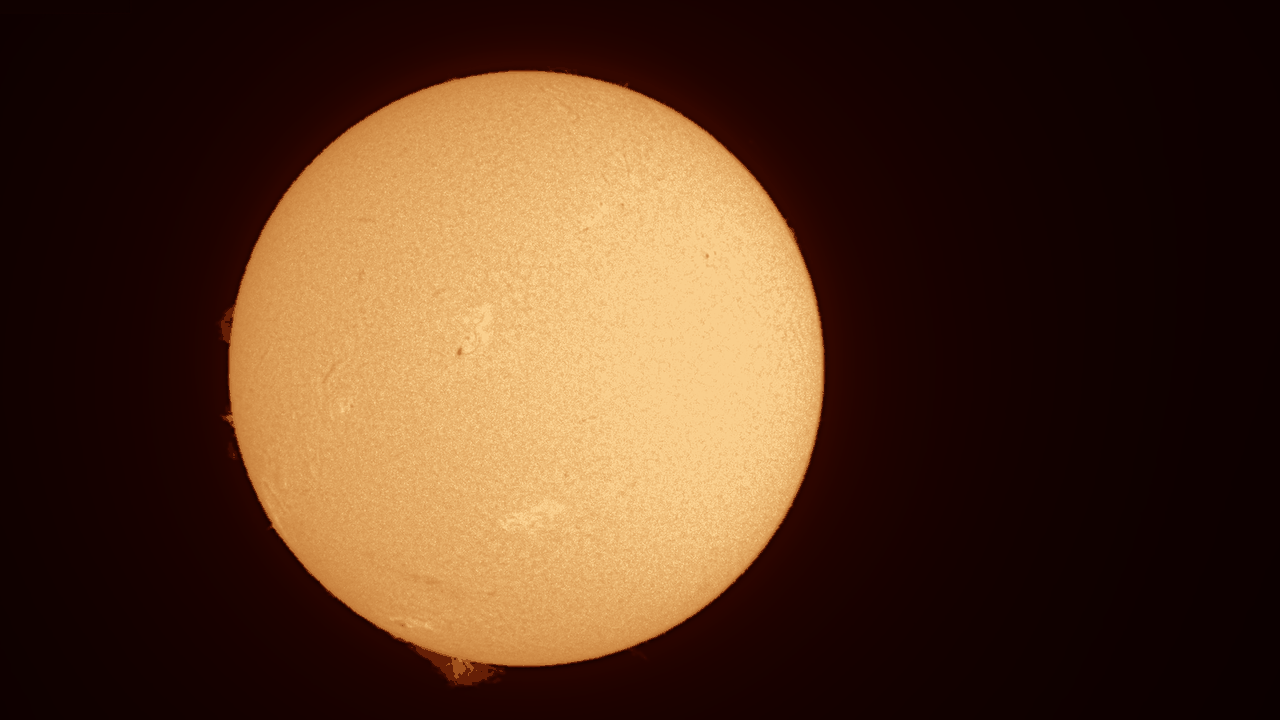
The result, reduced in size:
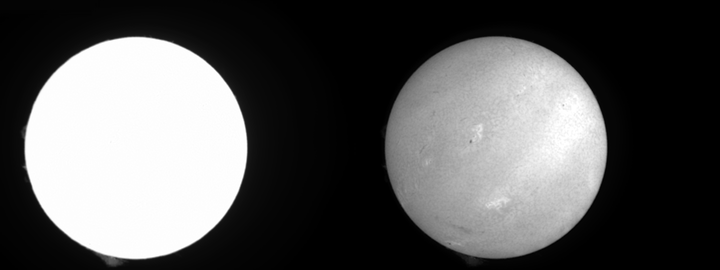
A clipped red plane
H-alpha lights the red pixels of a colour camera, and an exposure long enough to
show the prominences clips them: on the owner's real captures (ZWO ASI482MC, 2022 and
2026) 92 to 100 per cent of the red pixels of the disc sit at one value, so the red
stack is a flat white disc. The green pixels pass a little of the line, 40 to 60 per
cent of scale, and carry the filaments, plage and fibrils. Helia looks at a few
frames, sees the plateau, and stacks the green plane (channel: in the output
names it); name a channel with --channel to override. Lowering the exposure or
gain until the red plane is no longer flat gives the best picture.
Measured on 15_37_19.avi (the granulation band of helia measure, which on an
H-alpha disc reads the fine chromospheric mottle): red 0.14 per cent, green 1.39
per cent.
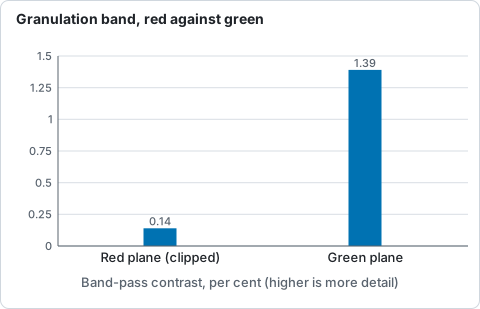
Granulation-band contrast of the stack from the red and the green plane of 15_37_19.avi, from helia measure.
Sharpening, measured
The preset wavelets were re-measured on four real H-alpha captures
(helia measure, 240 px disc-centre crop, the green plane). Against the old gains
(1.50, 1.45, 1.25, 1.05) the new ones (1.20, 1.60, 1.50, 1.10) leave the pixel
noise 14 points lower (fine band 1.24 to 1.31 times the unsharpened stack, was 1.41
to 1.46), the 1 to 4 px band the same or up (1.40 to 1.44 times, was 1.37 to 1.39)
and the fibril-scale band 10 points higher (1.31 to 1.34 times, was 1.19 to 1.22).
Layer 1 amplifies the noise most, so it is lifted least. The noise cuts changed
nothing measurable on these captures (cuts of 0 to 3 sigma on any layer moved the
bands by under 2 per cent).
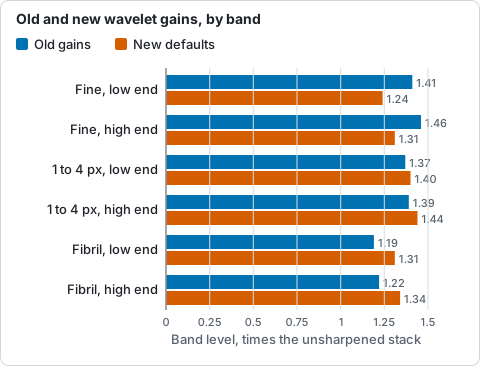
Band level as a multiple of the unsharpened stack for the old gains and the new defaults, ends of the ranges over four real captures, from helia measure.
Frames kept and alignment point size matter little here: 5 to 60 per cent of the frames changed the fibril band by under 10 per cent (more frames lower the noise by up to 14 per cent), and point windows from 35 to 300 arcsec gave fibril contrast within 5 per cent of each other, so the 25 per cent and 90 arcsec defaults stay.
Limb and prominences
The limb fit is not thrown by prominences, but they and the red halo bias it a
little: the radius fitted on the red plane (where the prominences glow) is 0.3 to
2.6 px larger than on the green plane (0.1 to 0.6 per cent) on the four real
captures, so the fit is good to under a per cent either way and the limb-darkening
profile is best read from the green plane when red is clipped. Prominences are
outside the disc, so the alignment points stay on the disc unless you ask for
--prominence-band PX; 20 or 40 px added 19 to 28 per cent more points and left the
disc contrast unchanged (the disc is what the measure sees), so use it when the
prominences are the subject and check them by eye.
If it is not right
- A fine grid: see Fixing a Bayer grid.
- Soft: keep fewer frames (
--keep 15%) in good seeing, or look at the quality curve in Analyse. - Halos or grain after sharpening: lower the gains, or see Troubleshooting.
- Prominences too faint: add Invert, or a second export with stronger levels. Prominences and disc differ greatly in brightness; a single picture cannot show both fully (HDR compositing is on the roadmap).