Tutorial 17: Stack a mosaic
Goal: turn a Seestar "mosaic mode" folder, where the camera visited several overlapping
parts of the target, into one image of the whole target, not just the part inside one frame.
You finish with mosaic.fits (colour, on a canvas larger than one frame), a coverage map and a
plate solution that proves the panes line up.
Data: the 167 raw 10-second S50 sub-frames of M 33 in a _mosaic_sub folder (IRCUT filter,
1080 x 1920 pixels, 2.376 arc seconds per pixel). Any folder of raw or debayered frames taken at
several pointings works. For how it works see How mosaics work.
Step 1: See the problem
...
note: 27 of 167 frames did not register to the reference. If they are other panes of a mosaic, stack with --mosaic to build one canvas.
140 of 167 frames stacked with LinearFit { low: 5.0, high: 2.5 }, reference frame 58 ...
A plain stack keeps one frame's grid: 1080 x 1920 pixels, the target cut off at a corner, and 27 frames dropped because they see another part of the sky.
Step 2: Stack as a mosaic
valerian stack M33_mosaic_sub/ --mosaic --mosaic-min-coverage 12 \
    --scratch-dir /big/disk -o mosaic.fits --coverage coverage.fits --report frames.txt
mosaic round 1: 27 frames placed, 14 anchors (one per pane)
mosaic: 16 panes found (anchors), 167 of 167 frames placed
mosaic canvas 2568 x 4390 pixels (1080 x 1920 for one frame), feather 120 px
mosaic levels matched: largest correction 3.5 ADU
combining 167 frames with LinearFit { low: 5.0, high: 2.5 }, weights NoiseFwhm on ... (28 GiB staged)
mosaic: cut to 2118 x 3627 pixels where at least 12 frames reach
167 of 167 frames stacked ...
Reading it:
27 frames placed, 14 anchors. The 27 frames that failed against the reference matched frames at neighbouring pointings. "Panes" here are pointings: this session drifted through 16 of them (the Seestar dithers between frames), not two or three tiles.canvas 2568 x 4390. The bounding box of all 167 frames. More than twice one frame in each direction.levels matched: largest correction 3.5 ADU. The additive level fitted to the worst frame. NGC 869 in the next section needed 1,450 ADU.cut to 2118 x 3627. Pixels that fewer than 12 frames reach are dropped and the canvas is trimmed; the depth ranged from 1 to 144 frames.
The run took 196 s and 2.9 GiB of memory on a shared 24-core machine (load 12 to 70, so an upper bound), plus about 30 GB of scratch disk that is removed when the run ends.
Step 3: Look at it
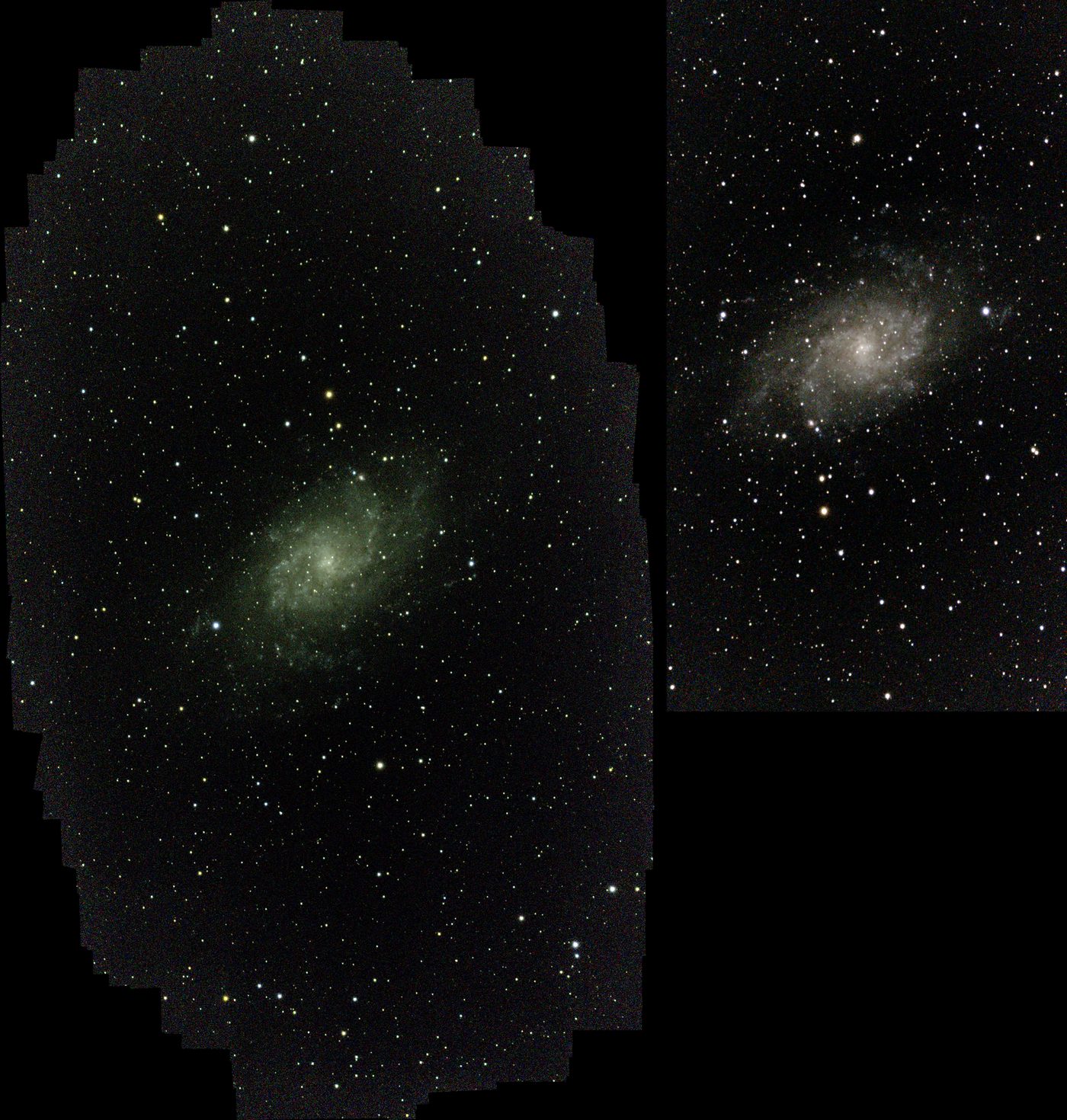
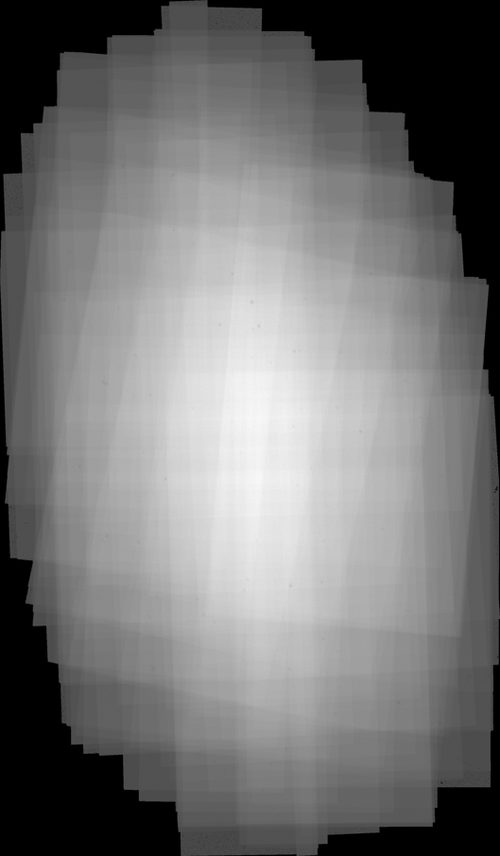
Left: Valerian, the whole 2118 x 3627 canvas. Right: the Seestar's own 1296 x 2304 stack of the same 167 frames, at the same scale and the same stretch. The Seestar keeps the deep middle; the Valerian canvas shows the same galaxy, the same stars in the same places and a wider field. Valerian's edge is ragged because the rim is where only a dozen or so frames overlap. The coverage map shows why:
Step 4: Check the registration
solved: centre RA 01h33m52.8s Dec +30d39m30.8s (23.46982, +30.65857 deg)
scale 2.374 arcsec/pixel, field 1.40 x 2.39 deg, rotation -108.64 deg east of north, mirrored
61 of 400 detected stars matched, rms 0.46 arcsec (0.19 px), plain TAN
A single plain TAN projection fits the whole 2118 x 3627 canvas to 0.19 pixel rms. A frame
placed wrongly would show as a double star and raise that figure. Then valerian background,
photocal and the rest of the chain work on the mosaic as on any stack.
Step 5: A mosaic with uneven panes
NGC 869, 46 frames of 20 s at six pointings, evening sky brightening and fading:
valerian stack NGC869_mosaic_sub/ --mosaic -o ngc869.fits
valerian stack NGC869_mosaic_sub/ --mosaic --no-mosaic-level-match -o ngc869_nolevel.fits
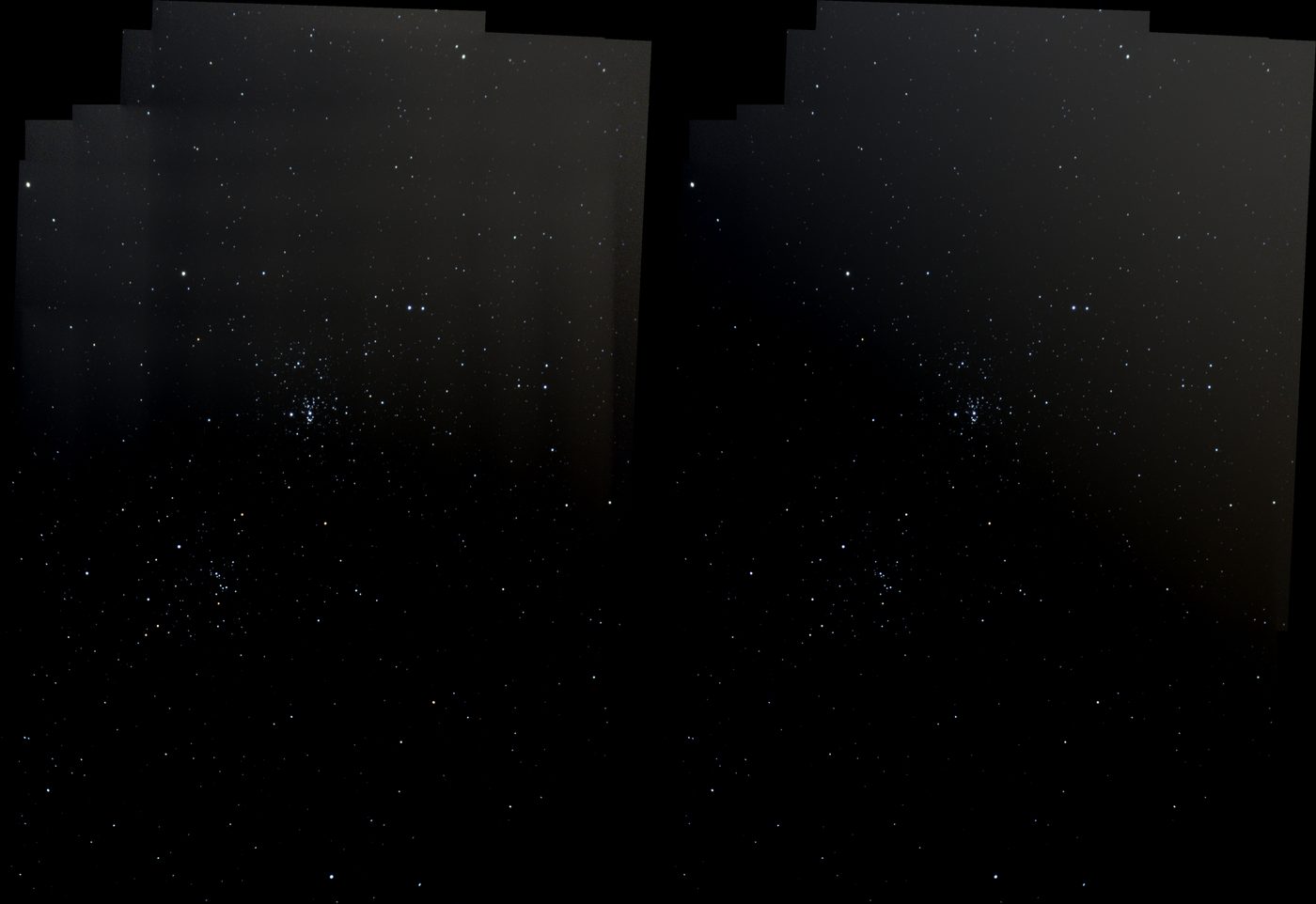
Without level matching (left) each pane keeps the level the usual normalisation gives it and
vertical steps show where panes meet. With it (right) the steps are gone; the smooth glow that
remains is a real sky gradient inside the panes and is the job of valerian background.
Options used
| Option | Meaning | Default |
|---|---|---|
--mosaic |
Register every pane onto one canvas | off |
--mosaic-feather PIXELS |
Width of the ramp at each frame edge (0 gives hard edges) | 120 |
--mosaic-min-coverage FRAMES |
Keep only pixels this many frames reach, trim the canvas | 1 |
--no-mosaic-level-match |
Skip the per-frame level fit | level fit on |
--scratch-dir DIR |
Where the staging file goes | system temporary directory |
How to tell it worked
- The log says
N of N frames placed, andvalerian solvehas an rms under about half a pixel. - The stars are round at the panes' overlaps. Doubled stars mean a bad registration.
- No bright or dark steps along straight lines that run across the canvas.
Troubleshooting
the mosaic canvas would be ... a registration put a frame in the wrong place. Some frame matched wrongly. Look at--reportfor frames with an odd shift, remove them (or usevalerian subframesand--approve) and rerun.- A frame is skipped with "no pane it overlaps either". It overlaps no other pane by 10 matched stars or more, usually because it is blurred or has few stars. That is normal for a few frames.
No space left on device. The staging file is large (about 30 GB here); use--scratch-dir.- A faint seam remains. Run
valerian backgroundon the result; raise--mosaic-featherto blend over a wider zone. - Sky outside the covered area is blank (NaN). That is "no data", as at the edge of any stack, not a black pixel.
Where next
Tutorial 5: Background extraction, then Tutorial 8: Plate solve and Tutorial 9: Photometric colour.